How to teach eco-painting
Using natural watercolours to elicit children's ecological understanding
Date & time
20 October 2026 | 17.00-19.00
Event format
Attend event in person
Event type
Participatory interactive event
Event topic
Education, Environment, My local area
Audience
Academic discipline
Education
Venue
Hillary Place G.18
Accessibility:
Assistive Listening System, Ergonomic Chair, Level Access (Audience), Level Access (Presenter), Wheelchair Access (Audience)
Accessibility information:
This room is flat with level access. The chairs have wheels and are mainly single arm with flip-up resting surfaces, however, there is a chair with arms if required. An infrared assistive listening system is fitted in this room. To use this facility…

Professional audiences
What's on offer?
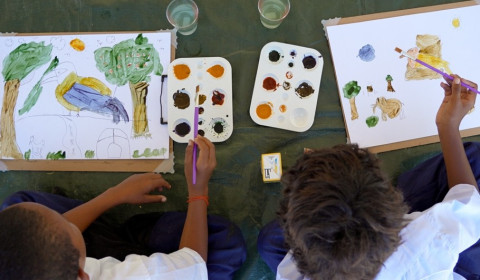
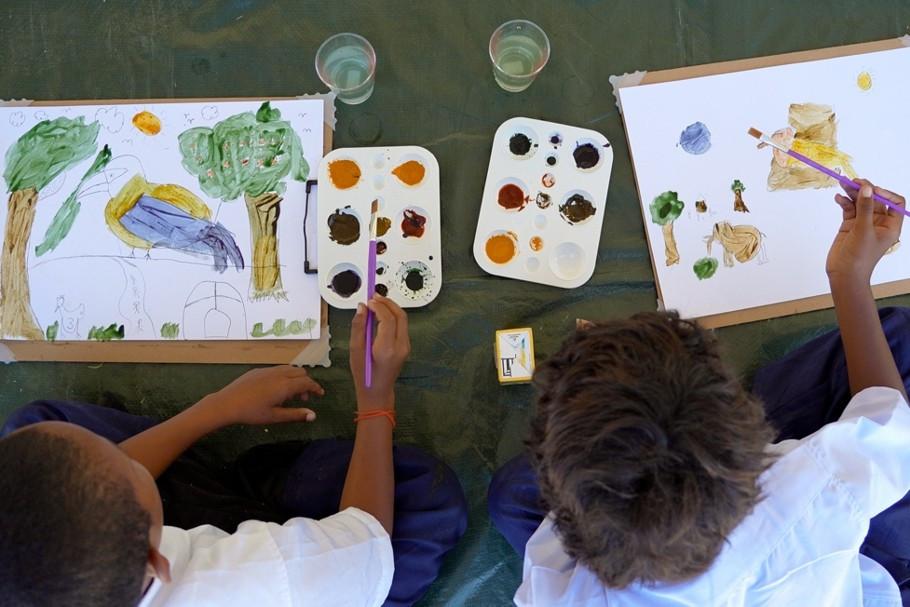
This two-hour, in-person practical workshop introduces primary schoolteachers and practitioners to eco-painting using natural watercolours. A 20-minute introduction to place-based ecological learning will be followed by a 60-minute hands-on session in which participants make natural watercolours and create artwork representing climate and nature. The main element is the practical eco-painting activity. Participants will then take part in a 20-minute storytelling and reflection circle before exploring how the approach can be adapted for Key Stages 1 and 2. All materials will be provided, and no previous artistic experience is required.
What's it about?
How can painting help children communicate what they know and understand about climate and nature? This workshop draws on the Voices of the Rainforest (https://voicesoftherainforest.leeds.ac.uk), which used natural watercolour-making, drawing and storytelling to explore Indigenous children’s ecological understanding in Malaysia.
Participants will learn how to create natural watercolours from locally available materials, such as leaves, flowers, berries, soil and charcoal. They will experience a drawing activity designed to elicit ecological understanding and explore how storytelling can reveal knowledge, experiences and relationships that may not be visible in children’s artwork alone.
The workshop will consider how eco-painting can support place-based learning by encouraging children to observe local plants, animals, landscapes, weather and seasonal change. It will also examine connections across Art and Design, Science and Geography within the National Curriculum for England.
Participants will leave with practical ideas for using eco-painting with children across Key Stages 1 and 2, including guidance on collecting materials responsibly, facilitating reflective discussions and adapting activities to their own school grounds or local environment.
Who's leading the event?
Dr Syafiq Mat Noor
Lecturer in Climate Change Education
Syafiq research and scholarship focus on climate change education, particularly Education for Sustainable Development, local, traditional and Indigenous knowledge, curriculum development, and participatory action research. He pioneered Voices of the Rainforest, a research programme that works with Indigenous communities in Malaysia to co-create a climate change curriculum grounded in traditional ecological knowledge.
Open to
The workshop is primarily open to primary schoolteachers and practitioners working with children. We also welcome teaching assistants, trainee teachers, early-years practitioners, community educators, museum and outdoor-learning practitioners, and others who design or deliver educational activities for children.
No previous experience of painting, art education or climate change education is required.
Of particular interest to
The workshop will be of particular interest to those who want to use creative, practical and place-based approaches to help children explore climate and nature.
No previous experience of painting or making natural watercolours is required.
Event booking deadline
15 October 2026
Related events
More events from University of Leeds